As anti-tax as I generally am, I have to admit that there are times when tax policy, including significantly increased taxes, can and should be used to provide certain incentives for people to behave in desired ways.
Starkly contrasting Hillary Clinton's and John McCain's idiotic proposals earlier this year to suspend the federal gas tax, Charles Krauthammer proposes further increasing gasoline taxes because, as we are seeing now, higher gas prices cause consumers to alter their driving and car-buying habits, which in turn puts pressure on manufacturers to produce more fuel-efficient vehicles. It is a market-based approach that would be much more efficient, and more beneficial to the national economy, than a government-mandated corporate average fuel economy or ethanol mandates or suing the Saudis or whatever politically-inspired energy scam is en vogue this week in Washington, DC.
Will people like it? No. Will it be difficult to adjust to, at least in the short-term? Yes, especially for politicians for whom any tax-hike is a career-killer (which is all of them). But it would be effective.
Showing posts with label Economics. Show all posts
Showing posts with label Economics. Show all posts


1.4.08
The Welfare State will Eat Your Soul...
...or at least your checking account.
I discovered a draft post that somehow I failed to publish from last year. Samuelson's article may be from a year ago, but it's just as applicable today as last year.
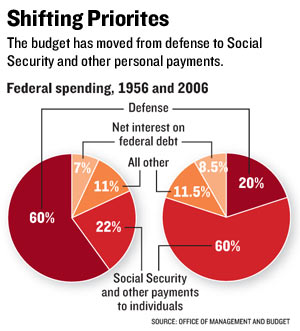
Economics writer Robert Samuelson has a new article out today (Feb 14, 2007) that puts much of the political battle over government spending into perspective. Neither party is willing to do much to rein in spending although both are eager to castigate each other for it.
It is useful to examine the chart Samuelson includes with his article. It shows the massive growth of welfare spending, especially as it compares to the decline of defense spending as a percentage of the government budget. These percentages are even more astounding when you realize that defense spending grew to a (numerically) record high of $520 billion for 2006 (including spending on Iraq and Afghanistan).
These figures are frightening enough today, but the real scare will hit us in the coming decades as our aging population retires and live longer lives, expecting government support for many more years than did their grandparents, without as many grandchildren to work and pay for it.
Subscribe to:
Posts (Atom)